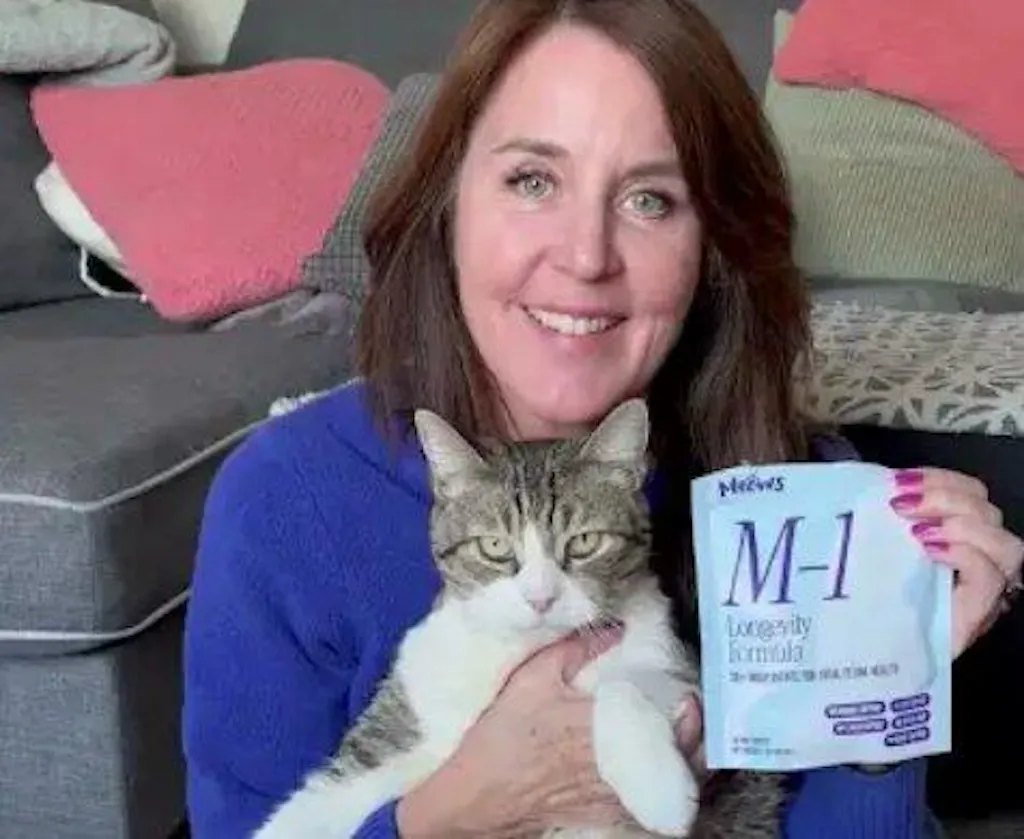
My Cat Stopped Jumping On The Fridge — A Founder’s Story
My Cat Stopped Jumping On The Fridge. Six Months Later I Could Feel His Spine Through His Fur.
I Refused The Plan. Discovered Why Almost Every Cat Breaks Down At The Same Age - And Built The Solution That Didn’t Exist

[HERO IMAGE — replace with: Mars on top of the fridge, looking down at camera]
The two things I saw and explained away
I thought it was hairballs.
Mars is a Bengal. He is the loudest animal I have ever lived with, and for about a month he’d been throwing up more than usual. Not dramatically. Just more.
Looking back, there were two other things. I noticed both. I talked myself out of both.
The first was the fridge. Mars had always cleared the top of the fridge in one jump. It was the thing he did. Guests would watch him do it. And at some point — I genuinely cannot tell you when — he started going up via the counter instead.
The second was his back. I stroke him the same way every night. Down the length of his spine, same hand, same route, for eight years.
Somewhere in that same window, I started being able to feel it. Not the shape of him. The actual bones. The knobs of the vertebrae under my palm. The shoulder blades standing proud.
He was eating. The bowl emptied every day like it always had. He was eight years old. Cats live past twenty.
So I said the sentence. The one I’d bet you have said, or are about to:
“He’s just getting older.” That sentence cost me nearly two years of not acting.
The scales
The first thing the vet did was put him on the scales. That’s when I found out Mars had lost weight. A real, measurable amount, over months.
I hadn’t seen it, because I saw him every single day. Nobody notices a cat disappearing at a few grams a week. You notice when your hand tells you.
Then the bloods. Then imaging. Then more imaging. I sat in that waiting room for most of a day and paid a number I still don’t enjoy saying out loud.
Three things came back.
One: his joints
Degenerative joint disease. Visible wear in the hips, on X-ray.
I asked how it was possible I hadn’t noticed. And the vet told me something I have thought about nearly every day since.
In a study where 100 cats were X-rayed at random — regardless of whether anyone thought anything was wrong with them — 92% had radiographic evidence of degenerative joint disease.
Ninety-two percent.
And here’s the part that turned my stomach. Cats with joint damage visible on X-ray show obvious lameness somewhere between 4% and 16.7% of the time.
They don’t limp. A limping cat in the wild is a dead cat, so evolution trained the limp out of them. They don’t cry. They don’t favour a leg. They don’t tell you.
They just quietly stop doing things.
They stop jumping on the fridge.
I hadn’t missed a subtle sign. I had watched the only sign there was, every day for months, and called it him getting older.

[IMAGE — replace with: the actual X-ray, if the clinic will release it]
Two: his heart
Hypertrophic cardiomyopathy. HCM.
The muscular wall of the heart thickens. The chamber holds less blood. The heart works harder for every single beat, forever.
It’s the most common heart disease in cats, and a leading cause of sudden death in Bengals specifically. There is usually no warning at all. A cat with HCM can look completely normal on a Tuesday and throw a clot that paralyses its back legs on a Wednesday.
I asked what we do about it.
Monitor. Medicate if it progresses.
Three: his kidneys
And then, because the day wasn’t finished, they told me about his kidneys.
This is the part I want every cat owner reading this to sit with, because almost nobody knows it.
The standard kidney test your vet runs — creatinine — does not rise above the normal range until roughly 75% of kidney function is already gone.
Not 20%. Not half. Three quarters.
By the time the result comes back abnormal, most of the organ is behind you. Chronic kidney disease affects an estimated 30–40% of cats over ten and is a leading cause of death in older cats — and the standard test cannot see it coming until it is most of the way finished.
Mars’s number was elevated.
Three diseases. One afternoon. Eight years old.

[IMAGE — replace with: the bloodwork printout]
One scoop a day, into wet food. Built for exactly this window — the years where it’s all happening and nothing looks wrong yet.
SEE WHAT’S IN MEOWS M-1 — 50% OFF FIRST MONTH →The two words
I asked what the plan was.
She was kind about it. Monitor the heart. Manage the joints for comfort. Renal diet. Recheck in six months.
Then she said it.
“At this stage it’s really about keeping him comfortable.”
Comfortable.
I knew exactly what I was being told. The plan was to watch him decline slowly and make it hurt as little as possible.
I drove home with him yowling in the carrier the way he always does.
And somewhere on that drive I stopped accepting that plan.
What a cat is actually built to eat
I’m not a vet. I’m a marketer. What I’m good at is reading everything ever written about something and refusing to stop until it makes sense.
So I read. Feline nutrition papers. Internal medicine. The entire history of how commercial cat food came to exist. I spoke to vets. I annoyed several of them.
And I kept hitting the same question:
Why do these exact four things — joints, heart, kidneys, muscle — show up in almost every cat, at almost the same age, in an animal that in the wild routinely lives past fifteen?
Here is what a cat eats when nobody is feeding it.
It eats the whole animal.
1. The cartilage around every joint — which is where glucosamine and chondroitin actually come from in nature.
2. The heart muscle — one of the densest natural sources of taurine on earth. Cats can’t make enough taurine themselves. They have to eat it.
3. The organs. The connective tissue. The fat, which carries the omega-3s. And the water — prey is roughly 70% water.
Cats descend from desert animals, which is why their thirst drive is famously, dangerously weak — for millions of years they never needed one. A wild cat drinks its dinner.
Now picture a bowl of dry food.
Cartilage: gone. Organ content: minimal. Moisture: about 10%.
We took a desert carnivore that drinks its meals, and we handed it a bowl of dust.

[ILLUSTRATION — replace with: whole prey vs. bowl of kibble, side by side. Commission this.]
The part that explained his spine
Everything above explained the fridge.
It did not explain his back.
He was eating. The bowl emptied. So why was he disappearing?
Then I found the research on how older cats digest, and I put my laptop down.
Cats lose the ability to absorb their own food as they age. Not their appetite. Their absorption.
Reduced fat digestibility affects 10–15% of cats aged 8–12, and 30% of cats over 12. In some geriatric cats, fat digestibility has been measured as low as 30% — and the only outward signs were bigger stools and a lighter cat.
Around 20% of cats over 14 lose protein digestion as well.
And the fact that reframes everything: unlike dogs, and unlike us, elderly cats need MORE energy as they age, not less — driven partly by that progressive failure to digest fat and protein.
Read that last one again, because every “senior formula” on the shelf implies the exact opposite.
Mars wasn’t eating less. He was absorbing less.
Same bowl. Same appetite. Same happy cat at the same time every morning. And underneath it, a quiet daily shortfall — a cat running a deficit and borrowing from the only reserve he had left.
His own muscle.
That’s what I was feeling under my hand every night. Not age. Sarcopenia — the loss of lean body mass — documented in cats from the age of seven, and which after twelve makes being underweight a bigger threat to a cat’s life than obesity ever was.
The spine I could suddenly feel was Mars eating himself to stay alive.
[DIAGRAM — THE MOST IMPORTANT ASSET ON THE PAGE. Replace with: full bowl going in, a fraction being absorbed, the gap labelled THE DEFICIT.]
The deficit is the whole problem. Meows M-1 was built to close it.
START THE 30-DAY TRIAL — 50% OFF →Free shipping · Cancel anytime · Empty-bag refund
What nobody knew for thirty years
This is the piece of research that changed how I thought about all of it.
Through the 1970s and early 80s, vets across the developed world watched cats die of a heart condition called dilated cardiomyopathy.
Thousands of them. Every year. Cause: unknown.
In 1987, a team at UC Davis published a paper in Science showing those cats were deficient in one amino acid. Taurine.
Cats can’t make enough of their own. They have to eat it. And the commercial food of that era didn’t contain enough of it. The same paper showed that supplementing taurine reversed the heart failure in most of the cats they treated.
The industry reformulated. Every complete commercial cat food today is taurine-fortified, and I want to be straight with you about that:
I am not telling you your cat’s food is missing taurine. It isn’t.
I’m telling you something else.
For thirty years, the entire global pet food industry did not know that cats needed it.
Cats died in their thousands from a cause recorded as unknown. It took a university team, in 1987, to find one missing molecule.
They found that one.
Sitting on my kitchen floor at 2am with a Bengal walking across my keyboard, the question I could not put down was this:
What haven’t they found yet?
Six bottles on the counter

[PHOTO — replace with: the six bottles on the real counter. Shoot this before you throw them out.]
I did what I imagine you’d do. I started buying things.
Glucosamine and chondroitin for the joints. An omega-3 oil. Taurine. Something for kidney support. A probiotic, because by then I understood the absorption problem. An antioxidant blend.
Six containers on my kitchen counter. Six scoops, six smells, six schedules, and one extremely opinionated Bengal who could detect any of them in wet food from the next room.
About £90 a month. Roughly half of it went in the bin, because he wouldn’t eat it.
And one morning, standing in front of all six of them before I’d even had coffee, I had the thought this article exists because of:
Why is this not one product?
One scoop. Covering what a cat used to get from eating a whole animal and now doesn’t. Built to taste like something a cat will actually eat — because a supplement your cat refuses is a supplement that does nothing at all.
I looked properly. It didn’t exist.
Everything on the shelf was single-issue. A joint one. A gut one. A coat one. Nothing was built around the actual question:
What is systematically missing — and what does its absence cost a cat over a lifetime?
The lie about seven
While I was formulating, one number kept making me angry.
Seven.
That’s when the pet industry starts calling your cat a senior. Senior food. Senior formula. Senior care. Seven.
Mars was eight. Barely over the line. Four systems already in decline.
But cats routinely reach fifteen. Plenty reach twenty. The oldest cat ever recorded — a tabby called Creme Puff, in Austin, Texas — reached thirty-eight.
So “senior at seven” isn’t biology. It’s a shelf category.
And what it does is teach us to expect decline at exactly the age when decline is most worth acting on — the age where a cat with early joint changes, dropping absorption and 60% kidney function still has a decade of good life in front of him, if somebody notices.
Almost nobody notices. Because we have all been taught that a slowing eight-year-old is just an eight-year-old.
Mars wasn’t old. Mars was running a deficit. And I was calling it age.
What we built

[PRODUCT SHOT — replace with: Meows M-1 bag + scoop + bowl of wet food]
I spent [X MONTHS] working with [VETERINARIAN NAME, CREDENTIALS] building the thing that should already have existed.
One formula. One chicken-flavoured scoop a day, stirred into wet food, where it disappears — because I designed it around the fussiest cat I have ever met.
If Mars eats it, yours will.
Twelve nutrients. Six systems. One scoop.
Joints & movement — 400mg chondroitin, 50mg glucosamine. The cushion between the bones, and the raw material to maintain it.
Muscle & absorption — L-lysine and Calcium-AKG to support lean mass, plus a probiotic blend for a gut that pulls less from the same bowl than it used to.
Kidneys — marine omega-3s, the nutrient class with the strongest evidence base for supporting kidney health in cats.
Heart & eyes — 200mg taurine daily, on top of whatever the food delivers.
Coat & skin — omega-3s and vitamin E. The shine comes back from underneath.
Cellular energy — NMN, CoQ10 and Calcium-AKG, studied for their role in cellular energy production, dosed for a cat.
Every dose printed on the bag, in milligrams. No proprietary blends. If a brand won’t tell you the dose, there’s a reason.
It’s built for cats who have already started to slow. And it’s built for cats who haven’t — because the entire lesson of that afternoon is that by the time you can see it, most of it has already happened.
One scoop. Twelve nutrients. Six systems.
START YOUR CAT’S FIRST 30 DAYS — 50% OFF →One scoop a day · Free shipping · Empty-bag refund
Where Mars is now

[IMAGE — replace with: Mars now. Warm, domestic, alive, on the fridge.]
I want to be straight with you here, because this is the paragraph where most pages like this one lie, and I’d rather you believed the rest of it.
Mars is not cured.
He still has HCM. He still has degenerative joint disease. His kidney numbers are still his kidney numbers.
No powder on earth reverses those, and anyone telling you otherwise is selling you something they shouldn’t be.
Here’s what I can tell you.
He’s ten now. He’s still here. He is loud, he is a menace, he wakes me at 4am for no reason, and he sleeps on my chest the way he always has.
He goes up to the top of the fridge. And I can’t feel his spine any more.
Not every time. Not like he did at three. But he goes.
That’s it. That’s the whole thing. Two physical facts I can check with my own hands. I check them constantly, because for a while I thought I was going to lose both.
That’s why this company exists. Not because I fixed my cat — I didn’t.
Because I got more of him.
And I can’t stop thinking about how many people are being told “he’s just getting older” about a cat with years left in him.
Two things to do in the next ten seconds
Before you buy anything. These cost nothing and you can do them from where you’re sitting.
1. Run your hand down your cat’s spine. Can you feel the individual bones? The shoulder blades standing proud? If you can — and you couldn’t a year ago — that isn’t your cat getting old. That’s lean mass going somewhere.
2. Think of the highest thing your cat used to jump on. Do they still do it in one go? Or is there a chair, a stool, a stopping point that wasn’t there before?
If either of those landed, you already know why you’re still reading.
What other cat owners are saying
⭐⭐⭐⭐⭐ Verified Review — “The counter thing. That was mine.”
“I read the bit about the fridge and went and looked at my cat. She’d been going up to the windowsill via the radiator for I don’t know how long. Six weeks in and she’s going straight up again. I nearly cried.”
— [NAME], [CITY] · Cat: [NAME], [AGE]
⭐⭐⭐⭐⭐ Verified Review — “He actually eats it”
“I’ve thrown away three joint supplements. He smells everything. This one goes into his wet food and he doesn’t even look up. That alone is worth it.”
— [NAME], [CITY] · Cat: [NAME], [AGE]
⭐⭐⭐⭐⭐ Verified Review — “Doses on the bag”
“I compared it against the four things I was already buying. Same actives, higher doses on two of them, and I know exactly what he’s getting. Cancelled the other four.”
— [NAME], [CITY] · Cat: [NAME], [AGE]
[CUSTOMER PHOTO GRID — the images below are placeholders; replace with real customer cat photos]


Formulated with a vet

[HEADSHOT — replace with: VETERINARIAN NAME, CREDENTIALS]
[VET PULL QUOTE — 2–3 sentences on why the absorption decline in older cats is under-discussed, and why a single daily addition to wet food is the realistic intervention for most owners. Must be a real quote from a real vet who genuinely worked on the formula.]
— [VETERINARIAN NAME, CREDENTIALS]
The offer, plainly
Meows M-1 — 50% off your first month.
One scoop a day, stirred into wet food.
✓ Free shipping
✓ Cancel any time, no phone call
✓ Every dose printed in milligrams
✓ Empty-bag guarantee — if you don’t see a difference in 30 days, send us the empty bag and we’ll refund every cent. You don’t have to send back what’s left. Just the bag.
Meows M-1 — 50% off your first month.
START THE FIRST 30 DAYS — 50% OFF →More than one cat? Select 2 or 3 at checkout.
Questions people ask before they order
- My cat is only 5. Is this too early?
- It’s the opposite problem. The joint changes, the absorption decline and the lean-mass loss are all documented from around age seven, and none of them announce themselves. The whole reason this page exists is that by the time you can see it, most of it has already happened.
- My cat is 15. Is it too late?
- No. The absorption decline is steepest in the oldest cats, which is exactly the group running the biggest daily shortfall. Talk to your vet first if your cat is on medication or a prescription renal diet.
- Will she eat it?
- It’s chicken-flavoured and formulated to disappear into wet food. It was designed around a Bengal who can detect a crushed tablet from another room. If she won’t touch it, that’s what the empty-bag guarantee is for.
- Can I use it alongside her food / her prescription diet?
- It’s a daily addition, not a replacement. If your cat is on a prescription diet or medication, check with your vet — genuinely, not as a disclaimer.
- Does this replace going to the vet?
- No, and I’d rather lose the sale than have you think it does. If your cat is vomiting, losing weight, drinking more, or has changed their litter box habits, book an appointment. Mars’s whole story starts with me not doing that for six months.
- What if it doesn’t do anything?
- Send us the empty bag. Full refund. No form, no phone tree.
Comments
THIS IS AN ADVERTORIAL AND NOT A NEWS ARTICLE, BLOG, OR CONSUMER PROTECTION UPDATE
© 2026 Meows Cat Health. All rights reserved.
Meows M-1 is a nutritional supplement, not a medicine. It is not intended to diagnose, treat, cure or prevent any disease, and it is not a substitute for veterinary care. If your cat is showing signs of illness — vomiting, weight loss, reduced activity, or changes in drinking or litter box habits — please see a veterinarian.
Mars’s diagnoses and story are real and belong to our founder’s own cat. Individual results vary. Statements regarding joint disease prevalence, kidney function detection thresholds, age-related digestibility decline and the history of taurine deficiency are drawn from published veterinary literature — sources listed on our [research page].