Why Do Almost All Cats Break Down At The Same Age?
Senior Cat Health
Why Do Almost All Cats Break Down At The Same Age? Researchers Point To A Single Overlooked Culprit
Joints, heart, kidneys and muscle — four systems, one pattern, and a digestive decline most owners have never been told about.

[IMAGE — replace with: editorial photo of a senior cat, natural light, no branding]
It is one of the most consistent patterns in companion animal medicine: somewhere around the age of eight, cats begin to slow down in strikingly similar ways. The jumps shorten, then disappear. Sleep stretches longer. The coat dulls. And under the owner’s hand, the spine slowly becomes easy to feel.
For decades, the standard explanation was the simplest one — age itself. But a body of veterinary research suggests something more specific is happening, and that it begins years before most owners notice anything at all.
A decline that hides in plain sight
The numbers are stark. In one radiographic study, 92% of cats X-rayed at random showed degenerative joint changes — while observed lameness remains rare, because cats instinctively conceal pain. Hypertrophic cardiomyopathy, a thickening of the heart wall, is the most common feline heart disease and typically develops silently. And the standard kidney screening value does not exceed the normal range until roughly 75% of function is already lost.
Three organ systems, one shared trait: by the time the signs are visible, most of the change has already happened.
The digestive link
What connects them may sit in the gut. Published work on feline digestibility shows that 10–15% of cats aged 8–12 have measurably reduced fat absorption — rising to 30% of cats over 12 — while around 20% of cats over 14 lose protein absorption as well. Meanwhile, unlike dogs or humans, a cat’s energy requirement increases in old age.
The arithmetic is unforgiving: the same bowl empties every day, less of it is absorbed each year, and the shortfall is paid from the body’s only reserve — lean muscle. Researchers have documented feline muscle loss from as early as age seven.
The founder who refused a “comfortable” decline
The pattern has begun to attract entrepreneurs as well as researchers. Jamie [SURNAME], founder of UK-born supplement company Meows, says the idea came from his own cat — a Bengal named Mars who received three diagnoses in a single afternoon at age eight, along with a treatment plan he summarises as “keeping him comfortable.”
“Mars was eating normally and disappearing anyway,” he says. “Nobody had ever told me that older cats absorb less of what they eat. Once I understood that, everything I’d wasted money on made sense — it was all going into a bowl, and the bowl wasn’t the problem.”
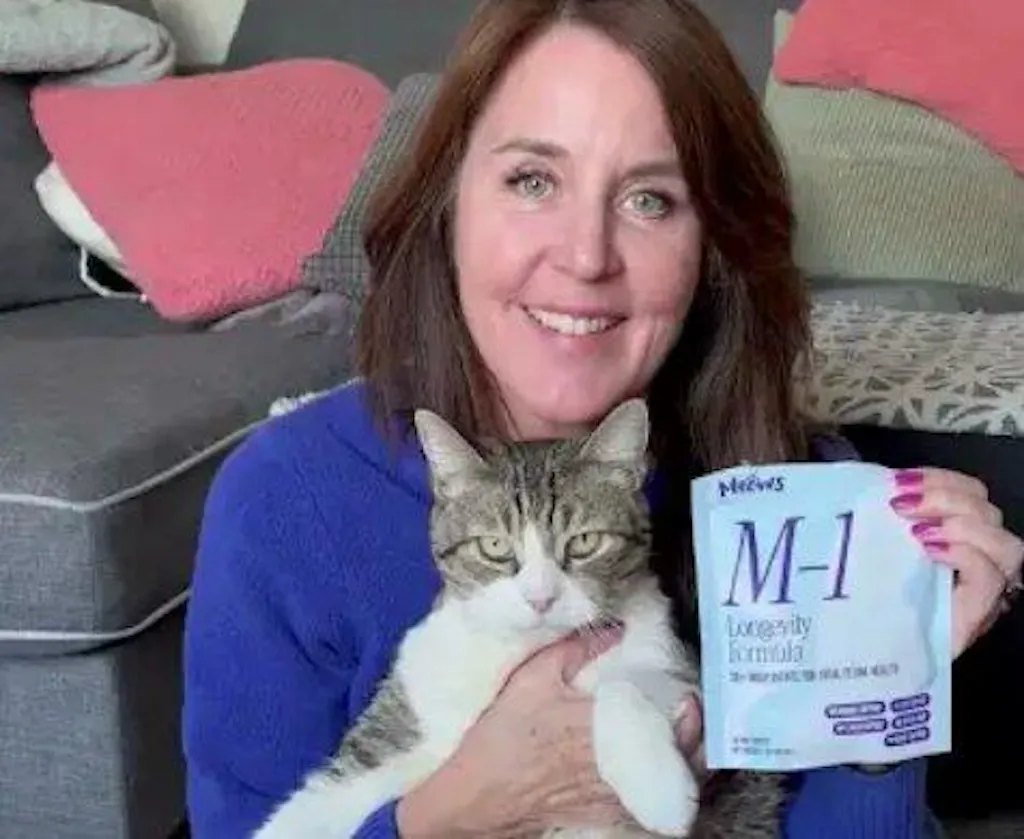
The result was Meows M-1, part of an emerging “absorption-first” category: a daily powder that pairs a probiotic blend intended to support the ageing gut with twelve nutrients across six systems — joints, muscle, kidneys, heart, coat and cellular energy — with every dose printed on the bag in milligrams.
[SURNAME] is careful about what he claims. “Mars still has his diagnoses. I won’t tell anyone otherwise,” he says. “What changed is behaviour — he jumps again, and I can’t feel his spine anymore. That’s what we’re for. Not miracles. Margins.”
What owners can do
- Feed wet food, with a splash of warm water — closer to a cat’s evolved moisture intake
- Run a monthly hands-on check along the spine and shoulder blades — newly prominent bones mean lean-mass loss, not “just age”
- Watch the jumps — a cat routing around a leap it used to make is the earliest visible sign
- See a vet promptly for vomiting, weight loss, increased drinking or litter box changes
Every dose printed in milligrams · Free shipping · 30-day empty-bag guarantee
SPONSORED FEATURE — DISCLOSURE: Feline Health Journal is a publication owned and operated by Meows Cat Health. This is an advertorial and not independent journalism.
This content is not veterinary advice and is not a substitute for examination and treatment by a licensed veterinarian. Meows M-1 is a nutritional supplement, not a medicine, and is not intended to diagnose, treat, cure or prevent any disease. Statistics cited are drawn from published veterinary literature — sources on our [research page]. Individual results vary.
© 2026 Meows Cat Health. All Rights Reserved. · Privacy · Terms