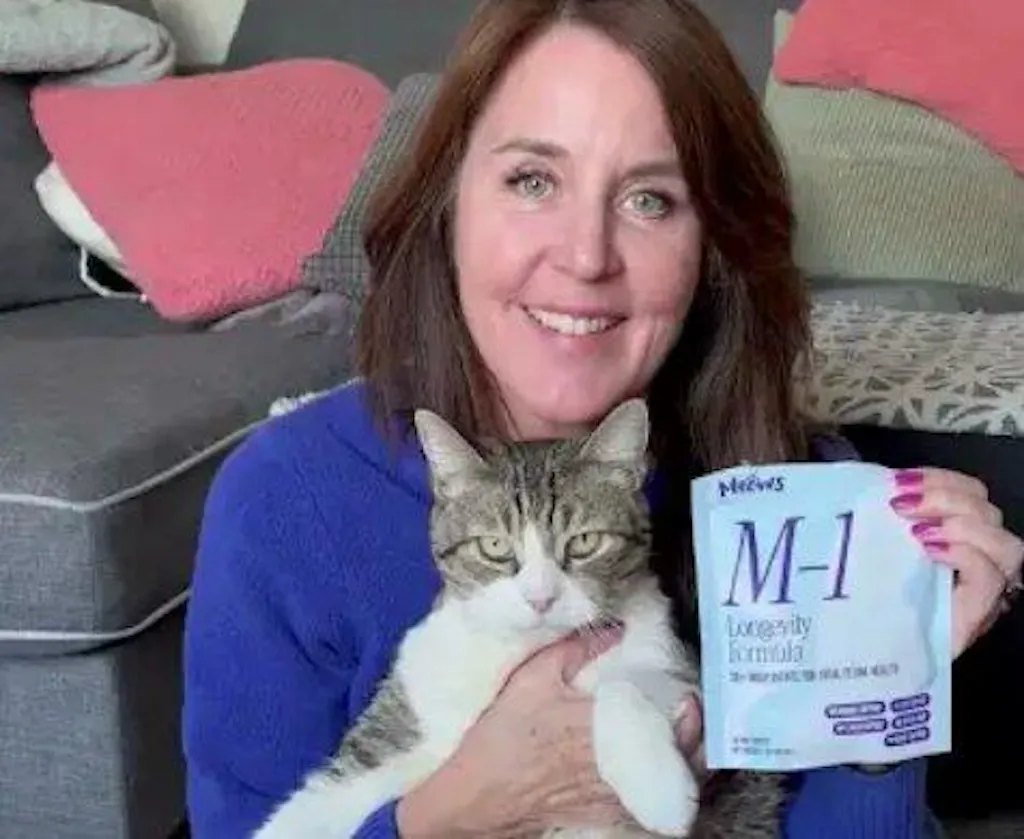
A Veterinarian’s Guide: The Overlooked Reason Senior Cats Decline
The Overlooked Reason Senior Cats Decline — And What I Tell My Clients To Do About It

Dr. Naomi Park, DVM
[CREDENTIALS · YEARS IN PRACTICE · LICENSE/REGION] · Formulating veterinarian, Meows M-1
[VERIFY before publish: Dr. Naomi Park DVM is the formulating vet, has approved this page, and signs every quote. Replace headshot with her real photo. This page fails FTC review without a real, named, consenting vet.]
If you own a cat over seven, there is a sentence you have probably said, or will say soon: “He’s just getting older.”
I hear it in the exam room every week. And in my experience, it is the single most costly assumption a cat owner can make — because what looks like “just ageing” usually has specific, measurable causes underneath it. Some of them can be acted on. Almost none of them announce themselves.
Three findings I see over and over in cats age 8+
Joints. In one radiographic study, 92% of cats X-rayed at random showed degenerative joint changes — yet observed lameness is rare. Cats hide pain. The sign isn’t a limp; it’s a jump that quietly disappears.
Heart. Hypertrophic cardiomyopathy — thickening of the heart wall — is the most common heart disease in cats, and it typically develops with no outward warning.
Kidneys. The standard screening value, creatinine, does not rise above normal until roughly 75% of kidney function is already lost. Chronic kidney disease affects an estimated 30–40% of cats over ten.
Three different organ systems. One common thread most owners have never heard of.
The absorption decline nobody explains to owners
As cats age, their digestive efficiency falls. This is documented in the veterinary literature: reduced fat digestibility affects 10–15% of cats aged 8–12 and around 30% of cats over 12; roughly 20% of cats over 14 show reduced protein digestion as well. At the same time — unlike dogs and unlike people — a cat’s energy requirement rises in old age.
The result is a quiet daily energy shortfall. The bowl empties, but less of it reaches the cat — and the body makes up the difference from lean muscle. That is why an owner’s hand often detects the problem before their eyes do: the spine and shoulder blades become palpable while the appetite looks completely normal.
“[VET QUOTE — real, in her words: why this decline is under-discussed with owners, and why she considers a daily addition to wet food the realistic intervention for most households.]” — Dr. Naomi Park, DVM
What I tell owners to do at home
1. Feed wet, add water. Cats descend from desert animals with a weak thirst drive; wet food with a splash of warm water is closer to how they evolved to take in moisture, and it supports the kidneys every day.
2. Do a monthly hands-on check. Run your hand down the spine and over the shoulder blades. If bones have become newly prominent, that is lean-mass loss — not “just age.” Book a weight check.
3. Watch the jumps, not the bowl. A cat that starts taking a chair-then-counter route to a place it used to reach in one leap is telling you something. Cats rarely limp; they route around pain.
4. Ask your vet about absorption-first supplementation. Adding nutrients to the bowl only helps if the gut can extract them — which is why I favour approaches that support the ageing digestive system first.
Why I helped formulate Meows M-1
When Meows’ founder approached me, his question was the right one: not “what can we add to the bowl,” but “what is failing between the bowl and the cat.” M-1 was built around that: a probiotic blend to support the ageing gut first, then twelve nutrients across the six systems the shortfall drains — joints, muscle, kidneys, heart, coat, and cellular energy. Every dose is printed on the bag in milligrams; there are no proprietary blends. It is a supplement, not a medicine: it does not treat or cure any condition, and it is not a substitute for veterinary care.
It is chicken-flavoured and designed to disappear into wet food — because in my experience, palatability failure is the number one reason feline supplements do nothing at all.
Every dose printed in milligrams · Free shipping · 30-day empty-bag guarantee
When to see your vet instead
No supplement replaces an examination. Book an appointment promptly if your cat is vomiting, losing weight, drinking noticeably more, hiding, or changing litter box habits — and speak to your vet before adding anything if your cat is on medication or a prescription diet.
DISCLOSURE: This page is owned and operated by Meows Cat Health. Dr. Naomi Park, DVM is the formulating veterinarian for Meows M-1 and is compensated by Meows. This is an advertorial and not independent editorial content.
Meows M-1 is a nutritional supplement, not a medicine. It is not intended to diagnose, treat, cure, or prevent any disease. Statistics cited are drawn from published veterinary literature — sources on our [research page]. Individual results vary.
© 2026 Meows Cat Health. All Rights Reserved. · Privacy · Terms