My 13-Year-Old Cat Stopped Jumping on the Counter. I Thought I Was Watching Him Get Old — Until a Vet Tech Told Me What Was Actually Missing.

"For two years I blamed his age. I was wrong about the one thing that mattered most."
I still feel guilty about how long it took me to notice.
His name is Theo. Orange tabby, thirteen years old, and the loudest purr in three counties. I've had him since he fit in one hand.
For most of his life, Theo ran the house. Up on the counter. Up on the fridge. On my chest at 6 a.m. whether I liked it or not.
And then, slowly, he just… stopped.
At First I Told Myself It Was Nothing
It didn't happen overnight. That's the part that fooled me.
First the fridge jumps stopped. Then the counter. Then he started taking the "stairs" I'd built out of storage bins instead of leaping onto the bed.
He slept more. A lot more. Sixteen, eighteen hours a day.
When he did get up, there was this pause before he moved — like he was bracing himself. And a stiffness in his back legs when he finally did.
I told myself what every cat owner tells themselves. He's a senior now. This is just what getting old looks like.
I was so sure of that story that I almost missed my chance to change it.
The Day I Realized How Bad It Had Gotten
The moment it hit me was small and stupid.
I shook the treat bag — the sound that used to bring him sprinting from anywhere in the house — and he just lifted his head from the couch and looked at me.
He wanted to come. I could see it. He just… didn't.

That night I picked him up and he flinched. My sweet, patient cat flinched when I touched him.
I sat on the kitchen floor and cried like an idiot. I felt like I was already losing him, and there was nothing I could do but watch.
I Tried Everything I Could Think Of (And Wasted A Lot Of Money)
I'm not the type to just accept things, so I started trying.
First, the vet. $240 for the visit, and the takeaway was basically "he's getting older, keep an eye on it." The meds they offered made him groggy and wobbly — he hated them, and honestly so did I.
Then the "joint health" treats from the pet store. Theo sniffed them once and walked away. The expensive bag sat in my cupboard going stale.
Then a powdered glucosamine thing I found online. Strong smell, and he refused any food I put it near. I was basically paying to make his dinner inedible.
Every option was either something he wouldn't eat, something that knocked him out, or something that did nothing at all.
And underneath all of it was that quiet, sinking belief: this is just age, and age doesn't have a fix.
That belief was the real problem. Not Theo's legs. My assumption.
The Offhand Comment That Changed Everything
It came from Karen, a friend from my book club who spent twenty years as a vet tech.
I was venting about Theo over coffee, half-expecting sympathy. Instead she put her cup down and said something I haven't stopped thinking about:
"Diane, 'old age' isn't a diagnosis. It's usually a nutrient gap nobody checked for."

She explained it in a way that finally made sense to me.
Indoor cats eat processed kibble their whole lives. And a lot of what their joints and bodies actually need to keep moving comfortably — the building blocks that cushion aging joints — isn't always present at meaningful amounts in a standard bowl of food.
So the cat doesn't slow down because he's "old." He slows down because, year after year, he's been quietly running low on the raw materials his body uses to stay mobile.
"Stiffness in a senior cat is often one of the first things to ease up," she told me, "once you actually put those nutrients back in."
I'd spent two years grieving something that might have been a nutrient gap the whole time.
What Karen Actually Recommended
She told me to stop buying random "joint treats" and look for one daily formula that put the real joint-support nutrients back in at amounts that matter — and, crucially, that a picky cat would actually eat.
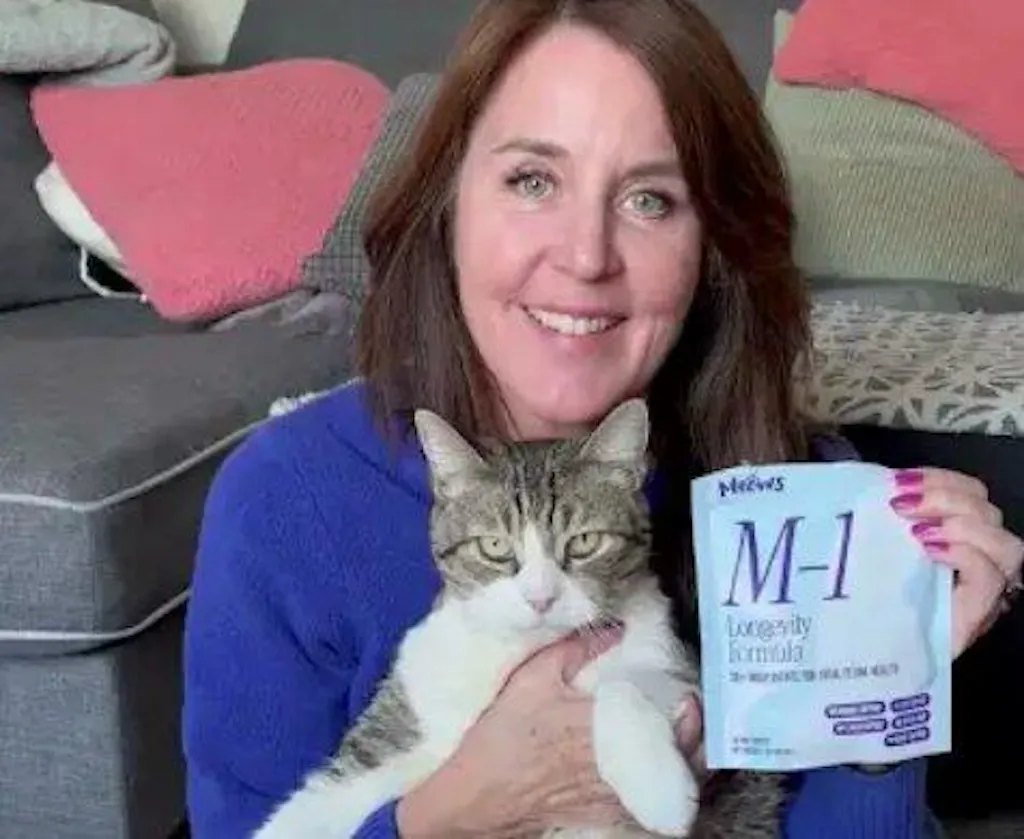
The one she kept seeing good results with was something called Meows Total Cat Health Formula.
What sold me wasn't the long ingredient list. It was the two she circled on the label.
Glucosamine and chondroitin — the building blocks that help cushion and support aging cartilage, the exact stuff that wears thin in a senior cat's joints.

Not a trace sprinkle "for marketing," she said. Research-backed levels. That's the difference between a formula that's doing the work and one that just looks good on a shelf.
But then she pointed at the rest of the label, and that's when it really clicked.
A standalone joint supplement — the good ones — runs $30 to $50 a month. And all it does is joints. Theo wasn't just stiff; he had a dull coat, more hairballs than usual, and the kind of low energy I'd been writing off as "old."
Meows had the research-backed joint nutrients and the rest of what an aging cat is quietly missing — omega-3s and vitamin E for coat, probiotics for digestion and hairballs, taurine and antioxidants for heart and immune support, CoQ10 for cellular energy. The whole cat, not one joint.
"You'd buy four different bottles to cover all this," Karen said. "This is one scoop, and it's less than most people pay for the joint stuff alone."
That was the part that got me. I'd been about to spend $40 on a joint powder that did one thing. This covered what four separate products would — for less.
It's a flavor-neutral powder. One scoop on his food, once a day. No pills. No syringe. No fight.
That last part is what made me actually believe it might work — because nothing works if your cat won't touch it.
The First Bowl (And The Weeks After)
I'll be honest: I expected another standoff.
I sprinkled half a scoop on his wet food that first morning, braced for the sniff-and-walk-away.

He ate the whole bowl.
The first week, nothing dramatic — I won't pretend there was. But around day twelve, his coat. It was softer. Glossier. People who hadn't seen him in a while started commenting.
And then, around three weeks in, I walked into the kitchen one morning and Theo was sitting on the counter.
On. The. Counter.
I hadn't seen him up there in nearly two years. I stood in the doorway and cried again — but a completely different kind of crying this time.


He's not a kitten. I'm not going to tell you he is. But he moves like a cat who isn't bracing himself anymore. He comes when the treat bag shakes. He's back on my chest at 6 a.m., whether I like it or not.
I like it.